AI won't make you faster
A few weeks ago I sat down on a Saturday, free from university for once, and by Sunday morning I had a working second brain. Not a folder of notes. A system that reads my sources, writes its own pages, links them together, and tells me what it changed. This week I handed it one messy conversation and it turned into ten connected pages before I had finished talking.
I want to tell you how that happened, because the interesting part is not the AI. It is what was already there before the AI showed up.
The thing I could not start
I first heard the "second brain" idea back in March, mostly through Nate B Jones, who keeps shaping how I think about this shift. (The clearest recipe I have read since is Andrej Karpathy's idea file: use the model to compile knowledge, not to answer questions.) I understood the concept the same day and then did nothing with it for two months. Every guide I found started in a different place, and I could not see where mine began.
That is the part most build-in-public posts quietly skip. The blocker was never the tooling. It was that I could not see the first move.
What actually unlocked it
It came in two separate pieces, and the order matters.
First, in May, I joined a track at Product Makers called "Get Work Done with AI Agents". Not a hype session. A practical, mentor-led space for product people working out where agents actually help: research, synthesis, planning, documentation, and the honest trade-offs. That gave me the frame.
Then, about a week later, I caught a separate hands-on Claude Code workshop with Ady Rugină (still running, currently 50% off). I built SEBI off the back of it, that same weekend. Weeks after, Ady flew in from London to teach the same material live at Product Jam 2026, and I finally met him in person, having already shipped my own version of it.
But the part I am proud of has nothing to do with either room. By then I had already spent weeks splitting my life into a structure inside Linear: initiatives, finances, community, the academic side, the people who matter. When I sat down to build, I was not designing a system. I was transcribing one that already lived in my head. That is why it worked by the next morning. The AI did not give me that head start. I already had it.
What SEBI actually is
No magic. It is a folder of markdown files and Claude Code wired to read and write them, with firm rules about what it can touch and what it cannot.
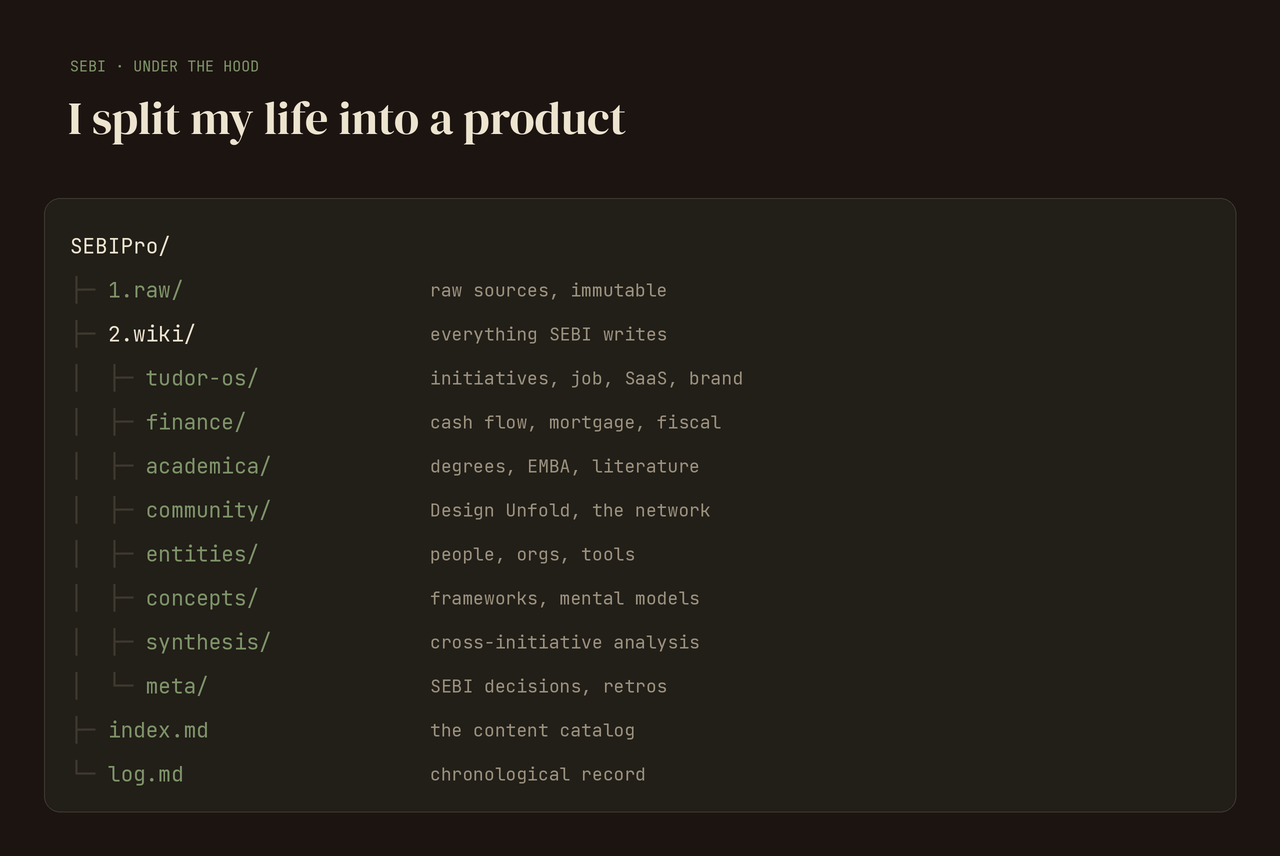
The name started as a joke that stuck. SEBI, from SEcond BraIn. The "Intelligence" came later, once the thing started teaching me back, so now it reads as Second Brain Intelligence. It also happens to be Sebastian, a name I like, which is part of why it stuck.
I am not going to oversell it. SEBI is a tool, not a colleague, and a genuinely valuable one. It is the kind of tool I was reluctant to reach for at first, until I understood what skipping it would cost me later. Start late and you pay it back with interest.
The receipts
The whole point of building in public is that I can show this instead of claiming it.
This week I gave SEBI one messy input: a long mentorship conversation, a PDF, and a pile of half-formed reactions. It produced a clean source page, updated five related pages, corrected something I had quietly been overstating about my own past, flagged a contradiction in my own archive, and logged the lot. One input, ten linked pages, and a paper trail of what changed and why.
It is not magic, and I will not pretend it is
The same week, I lost fifteen minutes arguing with a different AI over a formatting job I could have done by hand in five. It knew what I wanted and still made me drag it there. I will tell that story on its own, because the lesson in it matters. I said it in my first post and I will keep saying it: I will not pretend to be more AI-native than I am. That kind of debt always comes due at delivery.
The lever was never the AI
If there is one thing to take from this, it is this. The AI did not make me faster. Having already done the thinking made me faster. The tool only had to carry it the rest of the way.
So if you are stuck where I was in March, do not start with the tool. Start with the structure of your own work. The system is the thinking. The agent is only the part that writes it down.
I am building this one in the open, receipts and all. Stick around.
Later edit: a friend read this post, bought a license, and told me he still did not know where to start. So I wrote down the first move, step by step: see it in action here.
Comments